How to Clear a Green Pool Fast: The 4-Step Algae-Killing Guide (2026)
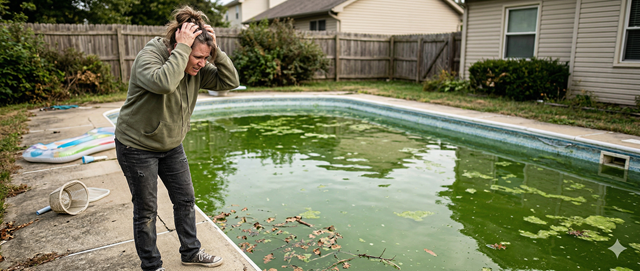
Walking out to a swampy, green pool is every homeowner's nightmare. But don't panic. A green pool usually means only one thing: **Algae has won the battle against your chlorine.** It is unsafe to swim in, but it is fixable. This guide breaks down the professional 'SLAM' method (Shock Level And Maintain) to turn your pool from swampy to sparkling in 24 to 48 hours.
The Truth About "Shocking"
Many pool owners make the mistake of just throwing in a single bag of powdered shock and hoping for the best. **This almost never works.** Algae is a living organism; you can't just annoy it—you have to eradicate it.
"Shocking" a pool isn't a product; it's a *process*. It means raising your Free Chlorine (FC) to a specific, highly elevated level and maintaining that level until all the algae is dead. This is known as the **SLAM method** (Shock Level And Maintain).
Stop Guessing on Chlorine Dosage
The amount of shock you need is *not* based on your pool size alone. It is based primarily on your **Cyanuric Acid (CYA)** level. Add too little, and you waste money as the algae eats the chlorine. Add too much, and you damage your liner. Use our free tool to get the precise fluid ounces needed for your exact chemistry.
👉 Use the Free Pool Shock CalculatorThe 4 Steps to Clear a Green Pool
Step 1: Physical Removal and Equipment Check
Before you add chemicals, you must physically remove as much algae food as possible. If there are leaves at the bottom of the pool, they will consume all your chlorine before it can kill the algae.
- Skim the surface to remove all floating debris.
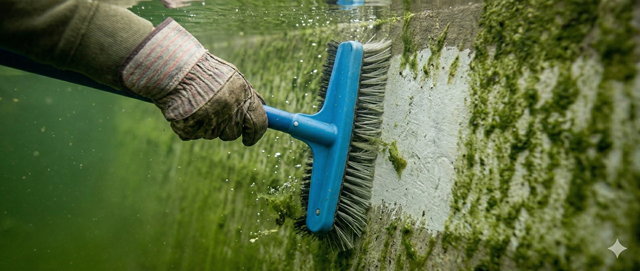
- Brush the entire pool (walls, steps, floor) to break up the protective layer of algae.
- Vacuum (ideally to "Waste" if using sand/DE, or rinse cartridge filters frequently).
- Clean your pump basket and skimmer baskets.
Step 2: Balance the Water Chemistry
Chlorine is extremely inefficient if your pH is high. Before shocking, you must lower your pH to **7.2**. Lowering the pH first makes your chlorine "activate" faster and stronger, saving you money.
Step 3: Test CYA and Calculate the Shock Dosage
This is the critical step. You must use a high-quality test kit (like a Taylor K-2006) to measure your Cyanuric Acid (CYA) level. CYA is a "sunscreen" for chlorine, but too much of it locks chlorine up. If you don't know your CYA level, you cannot successfully shock your pool.
Example: If your CYA is 40 ppm, your target Shock (SLAM) Level is **16 ppm**. If your CYA is 60 ppm, your target is **24 ppm**.
Step 4: Shock (SLAM) and Maintain the Level
We generally recommend using **Liquid Chlorine** (Sodium Hypochlorite) to shock a green pool. Powdered shocks (like Cal-Hypo or Dichlor) add extra Calcium or CYA to your pool that you may not want. Liquid chlorine is pure disinfectant.
Add the calculated amount of liquid chlorine after the sun goes down (so the sun doesn't burn it off). Keep your pump running 24/7. **You are not done until your water is crystal clear and you pass an Overnight Chlorine Loss Test (OCLT).**
Green Pool FAQ
No. It is unsafe. A green pool indicates a severe sanitizer deficiency. The same water that allows algae to bloom can also harbor dangerous bacteria, pathogens, and E. coli. Furthermore, if the water is too cloudy to see the main drain on the bottom, it presents a critical drowning hazard.
Liquid Chlorine (10% or 12.5% strength) is usually the best choice for eradicating algae. It acts instantly, does not cloud the water (like Cal-Hypo), and does not raise your Cyanuric Acid levels (like Dichlor bags).
There is no single answer. The dosage depends on your initial Cyanuric Acid (stabilizer) reading. A common starting dose for a 20,000-gallon pool with 40ppm CYA might be 3 to 4 gallons of 12.5% liquid chlorine, but you must test and adjust to maintain that level.
Ready to Get Started?
Don't spend another day looking at a green swamp.
Enter your pool size and chemistry readings. We'll give you a precise, professional chemistry plan to kill the algae and get your sparkling clear water back, instantly.
👉 Kill the Algae: Use the Shock Calculator